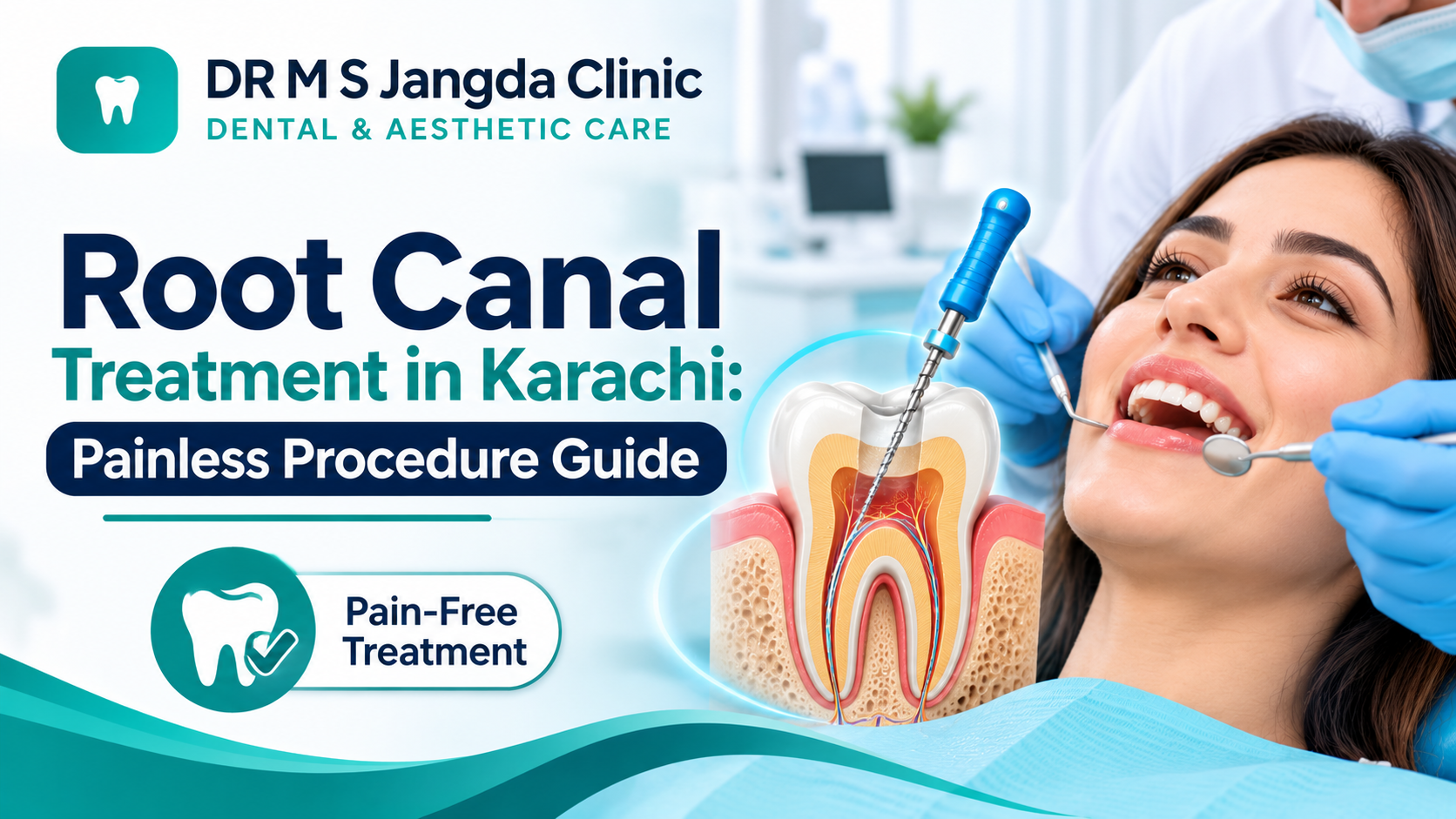
Few dental procedures carry a worse reputation than the root canal, and almost none of it is deserved anymore. The fear comes from an era before modern local anaesthetics, rotary instruments, and digital imaging. Today the discomfort most patients remember is from the toothache that brought them in, not from the treatment that fixed it.
This guide explains what root canal treatment actually involves, how a modern painless procedure works, what it costs in Karachi, how many visits to expect, and when severe tooth pain crosses into a dental emergency that should not wait until morning.
What a Root Canal Actually Is
Inside every tooth, beneath the hard enamel and dentine, sits a soft core called the pulp. It contains the nerve and blood supply that nourished the tooth while it was developing. When deep decay, a crack or repeated dental work lets bacteria reach that pulp, it becomes inflamed and then infected. Because the pulp sits in a sealed chamber with nowhere to swell, the pressure produces the distinctive, relentless ache people describe as the worst pain they have had.
Root canal treatment, properly called endodontic treatment, removes that infected pulp, cleans and shapes the narrow canals running down each root, disinfects them, and seals them with a filling material. The tooth stays in your mouth. It keeps functioning for biting and chewing, holds its position in the arch, and preserves the bone around it.
It is worth being clear about what the treatment does not do. It does not kill a healthy tooth, and it is not a last resort before extraction. It is the procedure that makes extraction unnecessary. A fully developed adult tooth does not need its pulp to survive; it draws what it needs from the surrounding tissues.
Signs You May Need Root Canal Treatment
Symptoms vary, and some infected teeth produce none at all, which is one reason regular check-ups matter. The common warning signs are:
- Persistent, deep toothache that is hard to pinpoint, often worse lying down at night
- Lingering sensitivity to hot or cold that continues for 30 seconds or more after the stimulus is removed, rather than fading immediately
- Pain on biting or pressure on one specific tooth
- A tooth that has darkened compared with its neighbours
- A swollen, tender gum near the tooth, or a small pimple-like bump on the gum that may discharge and taste unpleasant
- Swelling of the face or jaw on one side
- A deep cavity, a lost filling or a cracked tooth that has started hurting
- Pain that stopped suddenly after being severe, which can mean the pulp has died rather than healed
That last point deserves emphasis. When a badly infected tooth suddenly stops hurting, people often assume the problem has resolved. Usually the nerve has simply died, and the infection continues spreading into the bone at the root tip without the warning signal. Get it checked.
When It Is a Dental Emergency
Some of these signs mean same-day care rather than an appointment next week:
- Facial or jaw swelling, particularly if it is spreading or closing the eye
- Difficulty swallowing, breathing, or opening the mouth
- Fever alongside dental pain
- Severe pain that painkillers are not controlling
- A knocked out or badly fractured tooth after an injury
- Uncontrolled bleeding after a dental procedure
Swelling that affects breathing or swallowing is a hospital matter, not a clinic one. Go to an emergency department immediately. For the rest, emergency dental care in Karachi is the right route and the same day matters.
What Happens If an Infected Tooth Is Left
An infected pulp does not recover on its own. Antibiotics may quieten the symptoms for a while, but they cannot reach inside a tooth with no blood supply, so the infection returns once the course ends. Delay generally leads through a predictable sequence:
- The infection travels down the canals and out through the tip of the root into the surrounding bone.
- An abscess forms, which may drain through the gum or build into facial swelling.
- The bone at the root tip begins to dissolve, visible on an X-ray as a dark area.
- The tooth loosens as its support is lost.
- The tooth becomes unrestorable and has to be removed.
There is also a smaller but real risk of the infection spreading into the deeper tissues of the face and neck, which is a medical emergency rather than a dental inconvenience.
The cost arithmetic also favours acting early. Treating a tooth saves it. Losing it means an implant or a bridge to fill the gap, both of which cost considerably more than the root canal would have, or living with a space that lets neighbouring teeth drift and the opposing tooth over-erupt.
The Procedure Step by Step
1. Examination and X-ray
The dentist tests the tooth for response to cold and to tapping, and takes a periapical X-ray to see the root anatomy and any infection at the root tip. The number and curvature of the canals decide how long the treatment will take. Molars typically have three or four canals; a front tooth usually has one.
2. Anaesthesia
Local anaesthetic is given around the tooth, and for lower molars usually as a nerve block that numbs the whole side of the jaw. The dentist checks numbness before starting. This is the step that makes the procedure painless, and it is worth saying plainly: if you can feel sharpness at any point, say so, and more anaesthetic is given. A hot, acutely infected tooth can be harder to numb, which is one reason an abscessed tooth is sometimes settled first.
3. Isolation with a Rubber Dam
A thin sheet is placed over the tooth. It keeps saliva and bacteria out of the canals and stops anything falling to the back of your throat. It also means you can swallow normally during the appointment.
4. Opening the Tooth
A small access cavity is made through the biting surface, or the back of a front tooth, to reach the pulp chamber. Decayed tooth structure is removed at the same time.
5. Cleaning and Shaping with Rotary Endodontics
The infected pulp tissue is removed and the canals are cleaned and shaped. Modern practice uses nickel titanium rotary files driven by a controlled handpiece rather than the hand files of older technique, usually with an apex locator to measure the exact canal length. Rotary endodontics is faster, shapes canals more consistently, and is far less tiring for the patient than the repeated hand filing it replaced. Irrigating solutions flush the canals and disinfect them.
6. Filling and Sealing
Once the canals are clean, dry and shaped, they are filled with gutta percha, a rubber-like material, together with a sealer. This seals the space so bacteria cannot recolonise it. The access cavity is closed with a filling.
7. Final Restoration
A permanent restoration, usually a crown on a back tooth, is fitted afterwards. This is a separate appointment and is covered further below.
How Many Visits Will It Take?
Root canals are completed either in a single sitting or across two to three appointments. Neither approach is universally better; the right one depends on the tooth.
| Single sitting | Multiple visits | |
|---|---|---|
| Typical duration | 45 to 90 minutes, longer for molars | 30 to 60 minutes each |
| Best suited to | No active infection, straightforward canals, front teeth and premolars | Acute abscess, heavy swelling, complex or curved canals, retreatment |
| Between visits | Not applicable | Medicament placed inside the tooth and a temporary filling |
| Advantage | One appointment, one anaesthetic | Time for the infection to settle under medication |
A tooth with an active abscess is often better treated across visits, because an antibacterial dressing left inside the canal for a week or two reduces the bacterial load before sealing. A dentist proposing more visits for an infected molar is usually being careful rather than inflating the bill.
Expect molars to take longer than front teeth in either approach. Three or four narrow, curved canals simply require more time than one straight one.
Is It Painful? What Recovery Actually Feels Like
During Treatment
With adequate local anaesthetic you should feel pressure and vibration but not sharp pain. Patients routinely report the appointment being less unpleasant than the toothache that preceded it. If you are anxious, say so at the start: the dentist can work in shorter blocks, explain each step beforehand, and agree a hand signal for a pause.
Tell the dentist if you feel anything sharp. Needing extra anaesthetic is common, particularly for a hot lower molar, and is not a sign anything has gone wrong.
After Treatment
| Timeframe | What to expect |
|---|---|
| First few hours | Numbness fading; avoid chewing until it has gone to prevent biting your lip or cheek |
| Days 1 to 3 | Tenderness on biting, mild ache, usually controlled by ordinary painkillers |
| Days 4 to 7 | Discomfort settling steadily |
| After 1 week | Most people are comfortable; any gum swelling should have resolved |
Aftercare
- Take painkillers as advised by your dentist, and finish any antibiotic course prescribed
- Chew on the other side until the permanent restoration is fitted
- Avoid hard and sticky foods, which can dislodge a temporary filling
- Brush and floss normally, gently around the treated tooth
- Do not delay the crown appointment
When to Call the Clinic
Contact your dentist if severe pain lasts more than two or three days, if swelling appears or worsens, if the temporary filling comes out, if the bite feels high, or if you develop a fever. These are manageable problems, but not ones to wait out.
Why a Crown Usually Follows
A root treated tooth is structurally weaker than it was. It has lost tooth substance to decay and to the access cavity, and it no longer has the internal moisture supply it once had, which makes it more brittle. Back teeth take heavy chewing load, and an unprotected root treated molar can split vertically, which usually means losing the tooth for good.
This is why a dental crown is standard practice after root canal treatment on a premolar or molar. The crown covers the cusps and distributes biting force so the tooth does not fracture.
Front teeth with small access cavities and otherwise intact structure can sometimes be restored with a good composite filling rather than a crown. Your dentist will advise based on how much sound tooth structure remains.
Do not skip or delay the crown. This is the single most common reason a technically successful root canal fails. A temporary filling is not designed to last; it leaks over time, letting bacteria back into the sealed canals, and the tooth may fracture under load in the meantime. If budget is the obstacle, say so, and discuss an economy crown option rather than leaving the tooth temporarily restored for months.
Root Canal Treatment Cost in Karachi
Published prices across Karachi vary widely, partly by tooth and partly by clinic positioning. The ranges below reflect figures Karachi practices were publishing in 2026. They are for budgeting, not a quotation, and the crown is almost always charged separately.
| Item | Typical Karachi range (PKR) |
|---|---|
| Consultation and X-ray | 1,000 to 3,000 |
| Front tooth, single canal | 10,000 to 27,000 |
| Premolar, one to two canals | 12,000 to 30,000 |
| Molar, three to four canals | 15,000 to 40,000 |
| Retreatment of a failed root canal | 20,000 to 45,000 |
| Metal or economy crown | 10,000 to 18,000 |
| Porcelain fused to metal crown | 15,000 to 30,000 |
| Zirconia crown | 25,000 to 50,000 |
| Typical total, molar plus crown | 35,000 to 80,000 |
What Moves the Price
- The tooth. More canals means more time, so molars cost more than incisors.
- Complexity. Curved, calcified or extra canals, and retreatment of a previously filled tooth, all take longer.
- Technique and equipment. Rotary endodontics, apex locators and operating microscopes cost more than manual hand filing, and generally give more predictable results.
- Who treats you. An endodontic specialist charges more than a general dentist.
- Crown material. Zirconia costs considerably more than a metal crown and looks better, which matters most on visible teeth.
- Clinic location. DHA and Clifton practices sit at the upper end of each band.
Be cautious with a quote far below everything else in the city. The usual explanations are manual technique without an apex locator, no rubber dam, or a crown quietly left out of the figure. Ask for the total including the crown before you start, in writing.
Dental Emergency in Karachi: What to Do Before You Reach the Clinic
Not every toothache is an emergency, but some situations genuinely cannot wait.
| Situation | What to do now |
|---|---|
| Severe toothache | Take an ordinary painkiller as per the label, rinse with warm salt water, keep the head elevated when lying down, and call the clinic |
| Facial swelling | Call the clinic the same day. If swelling affects the eye, swallowing or breathing, go to a hospital emergency department immediately |
| Knocked out adult tooth | Hold it by the crown, not the root. If clean, reposition it gently in the socket and bite on a cloth. If not, keep it in milk or saliva and reach a dentist within the hour |
| Broken or chipped tooth | Save any fragment, rinse the mouth with warm water, cover a sharp edge with sugar-free gum, and get seen quickly |
| Lost filling or crown | Keep the area clean, avoid chewing on it, and book promptly before the tooth deteriorates |
| Abscess with a gum boil | Warm salt water rinses and same-day assessment. Do not squeeze or pierce it |
| Bleeding after extraction | Bite firmly on clean gauze for 20 minutes. If bleeding continues, contact the clinic |
Things Not to Do
- Do not place an aspirin tablet against the gum; it burns the soft tissue
- Do not apply heat to a swollen face, which encourages the infection to spread
- Do not start leftover antibiotics from an old prescription
- Do not try to drain an abscess yourself
- Do not assume pain that stopped means the problem resolved
Painkillers and antibiotics manage symptoms. They do not treat the cause, and a tooth that has settled on medication will flare again once it stops. If you are in Karachi and facing any of the above, emergency dental care is the route, and sooner is cheaper as well as safer.
Root Canal or Extraction?
Pulling the tooth is usually cheaper on the day and sounds simpler. It rarely is over a longer horizon.
| Root canal and crown | Extraction | |
|---|---|---|
| Tooth kept | Yes | No |
| Immediate cost | Higher | Lower |
| Cost of what follows | Crown only | Implant or bridge, or a gap |
| Chewing function | Preserved | Reduced on that side |
| Bone around the site | Maintained | Gradually resorbs |
| Neighbouring teeth | Unaffected | May drift; opposing tooth over-erupts |
With good treatment and a properly fitted crown, root treated teeth commonly last many years and often a lifetime. Published success rates for well executed endodontic treatment are high, though no dentist can promise an outcome for an individual tooth.
Extraction is still the right answer sometimes: a tooth split vertically through the root, one with too little structure left to restore, or severe bone loss from gum disease. A dentist who explains why extraction is unavoidable in your case, with the X-ray in front of you, is giving you better service than one who attempts to save anything regardless.
Choosing a Clinic in Karachi
- A dentist who takes an X-ray before quoting, and shows it to you
- Rubber dam isolation used as routine
- Rotary endodontics with an apex locator rather than hand filing alone
- A written treatment plan covering the root canal and the crown together
- Honest discussion of prognosis, including when the tooth may not be savable
- Clear sterilisation protocol and sealed instrument packs
- A follow-up appointment and someone reachable if pain develops afterwards
It also helps when one practice handles the whole sequence. You can see the full range of dental services, read about rotary endodontic root canal treatment, or book a consultation.
Frequently Asked Questions
Is root canal treatment painful?
With adequate local anaesthetic, you should feel pressure and vibration, not sharp pain. Most patients find the appointment easier than the toothache that preceded it. Tell the dentist if you feel anything sharp so more anaesthetic can be given.
How long does a root canal take?
Usually 45 to 90 minutes per appointment, longer for a molar with three or four canals and shorter for a single-canal front tooth.
How many appointments will I need?
One sitting is often enough for a straightforward tooth. Teeth with an active abscess or complex canals are commonly treated over two or three visits with a medicament left inside between them.
How much does root canal treatment cost in Karachi?
Broadly PKR 10,000 to 27,000 for a front tooth, 12,000 to 30,000 for a premolar and 15,000 to 40,000 for a molar, with the crown charged separately. Get a written total after examination.
Is the crown included in the price?
Almost never. Ask for the combined figure for the root canal plus the crown before starting.
Do I really need a crown afterwards?
On a premolar or molar, yes in nearly every case. Without one, the weakened tooth can split under chewing load, and the temporary filling leaks over time. Some front teeth can be restored with a composite filling instead.
What is rotary endodontics?
Canal cleaning and shaping with nickel titanium files driven by a controlled handpiece rather than manual hand files. It is faster, more consistent, and more comfortable for the patient.
Can I eat afterwards?
Wait until the numbness wears off to avoid biting your lip or cheek. Then chew on the other side and avoid hard or sticky food until the permanent restoration is fitted.
How long will the tooth last?
With a properly fitted crown and normal oral hygiene, commonly many years and often a lifetime. No individual outcome can be guaranteed.
Can a root canal fail?
Yes, usually from a missed canal, a leaking restoration, delayed crown placement, or a new fracture. Retreatment is often possible, and surgical options exist when it is not.
Will the tooth go dark?
Modern technique and a good coronal seal make this much less common than it once was. A front tooth that does darken can be treated with internal bleaching or a veneer or crown.
Is it safe during pregnancy?
Treating an active infection is generally considered safer than leaving it. The second trimester is usually preferred, and X-rays are taken with shielding. Tell your dentist you are pregnant.
Do I need antibiotics?
Not routinely. They are prescribed where there is spreading infection, swelling or fever, and they do not replace the treatment itself.
Can a tooth that stopped hurting still need treatment?
Yes. A sudden end to severe pain often means the nerve has died, while the infection continues into the bone unnoticed.
What if I cannot afford the crown right now?
Tell your dentist. An economy crown is better than an uncrowned tooth, and a short agreed timeline is better than leaving a temporary filling in place for months.
Is extraction a cheaper option?
On the day, yes. Replacing the tooth with an implant or bridge afterwards costs considerably more than the root canal and crown would have, and leaving a gap brings its own problems.